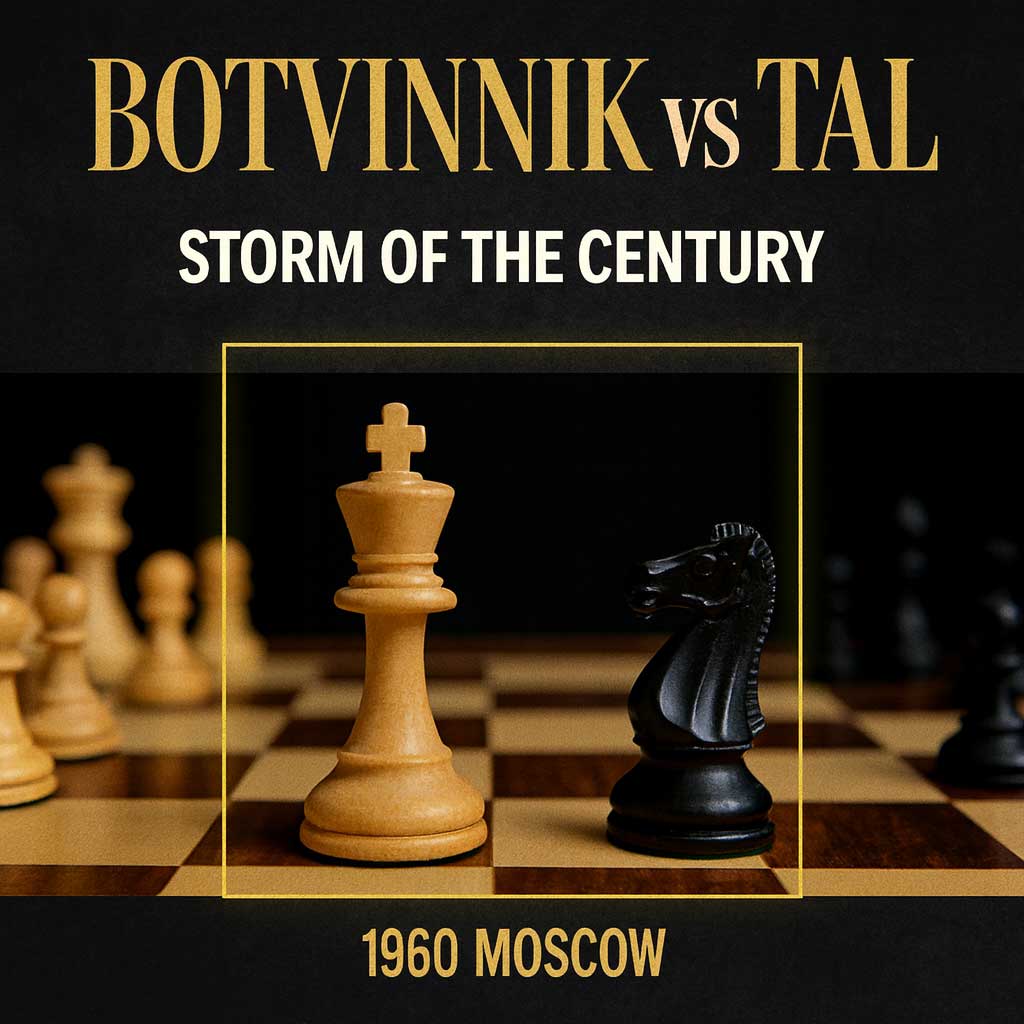
This World Championship game is iconic because Tal deliberately refused to retreat into passivity and instead played the legendary speculative sacrifice 21…Nf4!!—a move made “for almost no immediate returns” to fully activate his pieces and keep the position messy. It’s also famous for the atmosphere: the spectators became so excited that the game was moved to a back room due to the noise.
Why this game matters
- It was Game 6 of the 1960 World Chess Championship match, and it instantly became the defining “Tal” game of the event in many accounts.
- The sacrifice is a practical blueprint for dynamic chess: when your position is being squeezed, you can sometimes escape not by defending, but by changing the nature of the position with activity and threats.
- The legend around it is real: even contemporary summaries highlight how the crowd reaction was so intense that arbiters had to move the players backstage.
Key moments (quick guide)
- Botvinnik builds a position that, by classical standards, should reduce Tal’s counterplay and increase White’s advantage.
- Tal hits the “no retreat” button with 21…Nf4!!, sacrificing a knight to keep pieces active and complications alive.
- A major turning point comes later when Botvinnik chooses to trade queens—described in analyses as a fatal practical decision because Tal’s central pawn becomes too strong and the endgame turns clearly favorable for Black.
What to learn from it
In complex games, decision-making matters as much as calculation: trading queens can be a blunder if it transforms your opponent’s dynamic pressure (like a dangerous passed pawn) into a simple technical win.
When a position is strategically unpleasant, look for a forcing idea that improves piece activity and creates new problems, even if it costs material.
Speculative sacrifices work best when they “buy” coordination, open lines, and lasting initiative—Tal’s 21…Nf4!! is taught precisely as that kind of activation sacrifice.