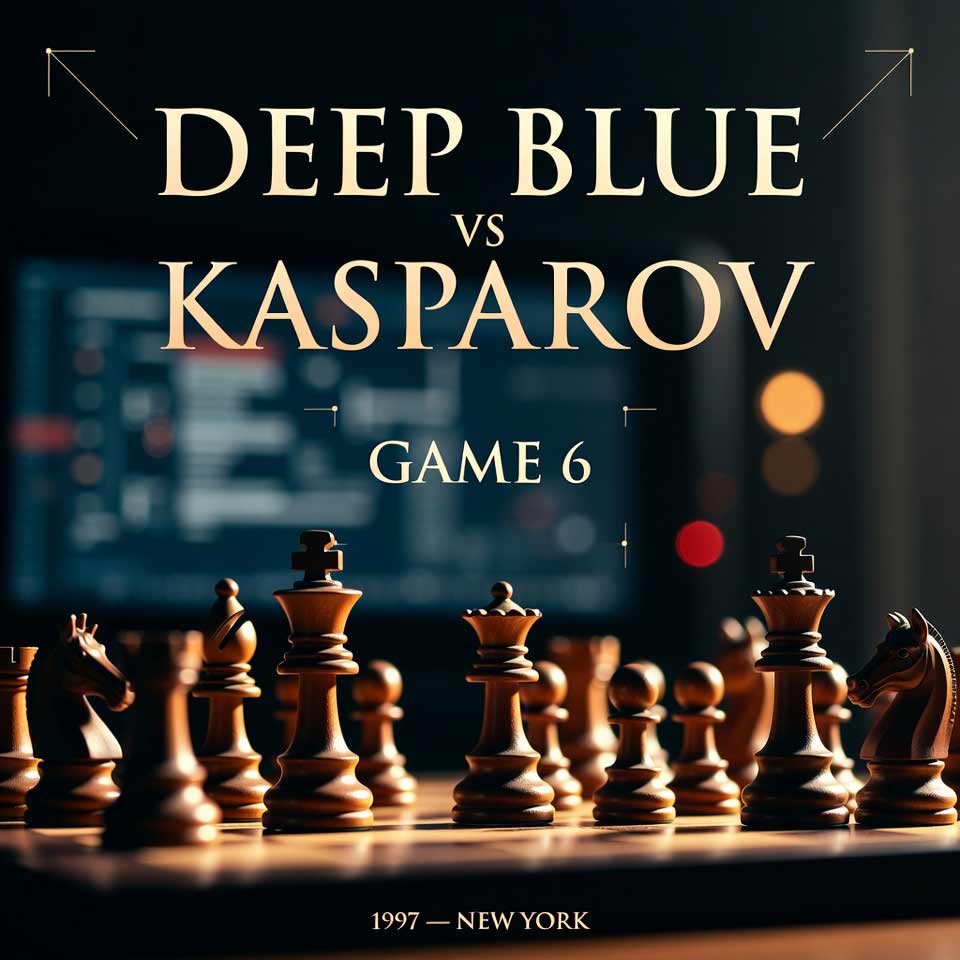
Deep Blue vs Kasparov, Game 6 (New York, May 11, 1997) is the ultimate “turning point” game: a 19-move miniature that decided the match and became the first time a computer defeated a reigning World Champion in a multi-game match under tournament conditions.
Why this game is iconic
This was the final game of the 1997 rematch, played with the overall score tied 2½–2½, so the winner took the match. Deep Blue’s win made it the first computer system to defeat a reigning World Champion in a match (Deep Blue won the rematch 3½–2½). The game drew huge attention because Kasparov resigned after only 19 moves in a game lasting barely more than an hour.
Context and opening
Kasparov chose the Caro–Kann Defense (Steinitz Variation, ECO B17), a solid opening he used in this match as a practical attempt to steer the computer away from sharper, more “booked-up” territory.
The critical moment is 7…h6?!, after which the well-known sacrifice 8.Nxe6! hits with maximum force and the position collapses quickly.
Critical moments of the game
- 7…h6?!: A risky/odd decision in this structure; it allows White’s classic refutation ideas to land immediately.
- 8.Nxe6!: Deep Blue plays the thematic knight sacrifice (also known from prior master practice) that wrecks Black’s coordination and king safety.
- 8…Qe7?!: Kasparov pins the knight instead of taking it at once; many annotators criticized this choice compared to immediate acceptance.
- 17.Bf5!: White’s pieces swarm the e6 weakness, and Black can’t keep the extra material without conceding the queen.
- 19.c4 and resignation: Kasparov resigns because White’s queen soon invades and after Re1 Black is strategically busted, published sample lines show the attack is decisive.
Lessons
- Against a well-prepared opponent (human or machine), “one tempo too early” pawn moves can be fatal in sharp theory.
- Sacrifices work best when they win coordination: after 8.Nxe6!, Black’s king is stuck, development is awkward, and White’s bishops dominate.
- In must-win/must-hold situations, choose structures you can defend confidently—Kasparov’s defensive task became extremely hard once castling was off the table.