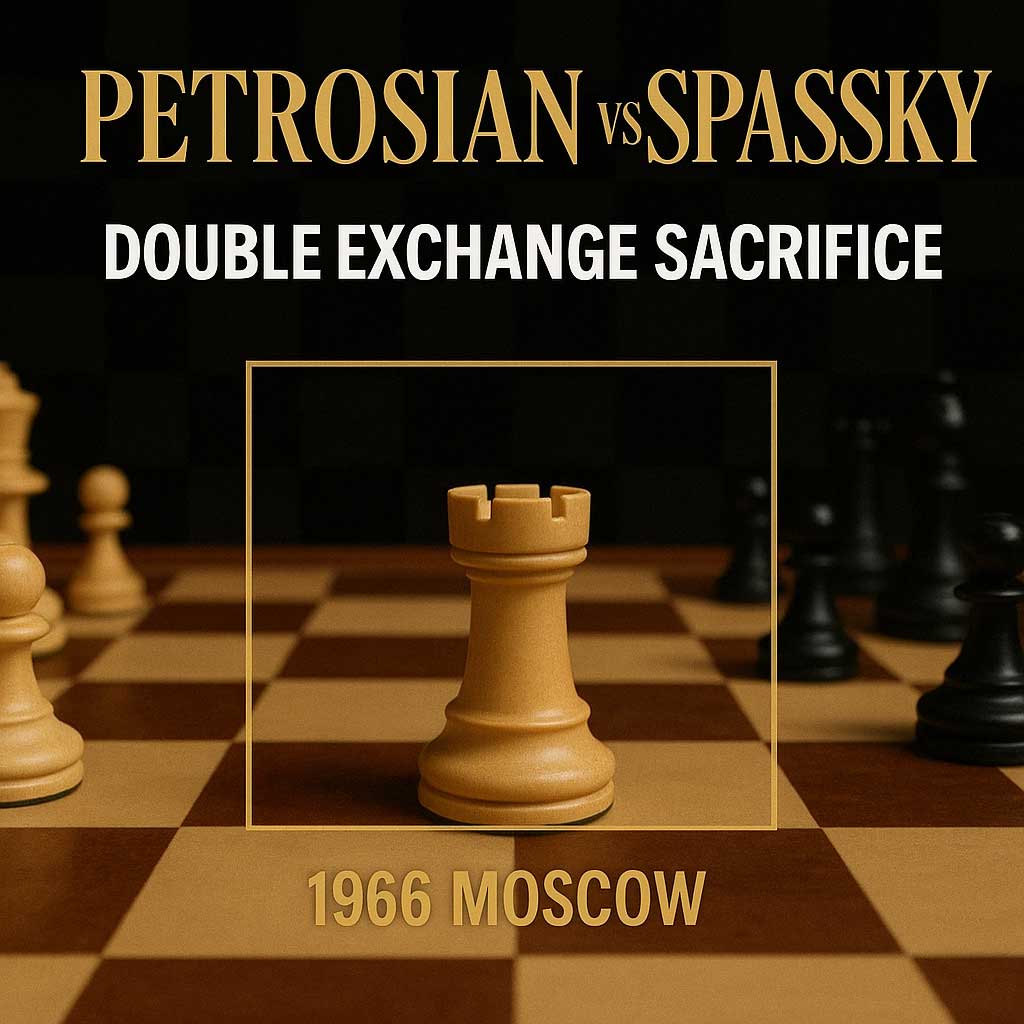
This World Championship game is iconic because Petrosian wins with a strategic double exchange sacrifice—giving up both rooks for long-term domination—rather than a one-shot mating attack. It’s one of the signature examples of Petrosian’s style: prophylaxis, control, then a precise transformation when the position is ready to crack.
Why this game matters
It was Game 10 of the 1966 World Chess Championship match in Moscow, and Petrosian’s win was a huge momentum swing in the match narrative. The opening reaches a King’s Indian (Fianchetto/Panno-type) structure where White’s plan is not “attack now,” but “take away counterplay,” and the payoff comes later. The finish is memorable because the rooks are sacrificed not for immediate fireworks, but to lock Spassky down and make the end position collapse under pressure.
Key moments (quick guide)
Petrosian uses quiet, re-routing moves (including a famous knight maneuver often highlighted in annotations) to prepare the right pawn breaks and deny Black active piece play. Then comes the headline idea: the position becomes so constrained that Petrosian can afford to trade rooks for minor pieces and pawns, because the remaining pieces coordinate perfectly while Black’s army can’t breathe. The game is frequently summarized around the “double exchange sacrifice” sequence (with the key rook capture idea emphasized in many commentaries) that converts a positional bind into a decisive result.
What to learn from it
- When facing a dynamic defense (like King’s Indian structures), first remove the opponent’s counterplay—then open the position on your terms.
- Exchange sacrifices aren’t only tactical: they can be purely strategic when they increase control, fix weaknesses, and leave the opponent with no active plan.
- Before any sacrifice, do a checklist: piece activity, king safety, and whether the opponent has active squares—Petrosian’s game is a model of “preparing the sacrifice” rather than improvising it.